
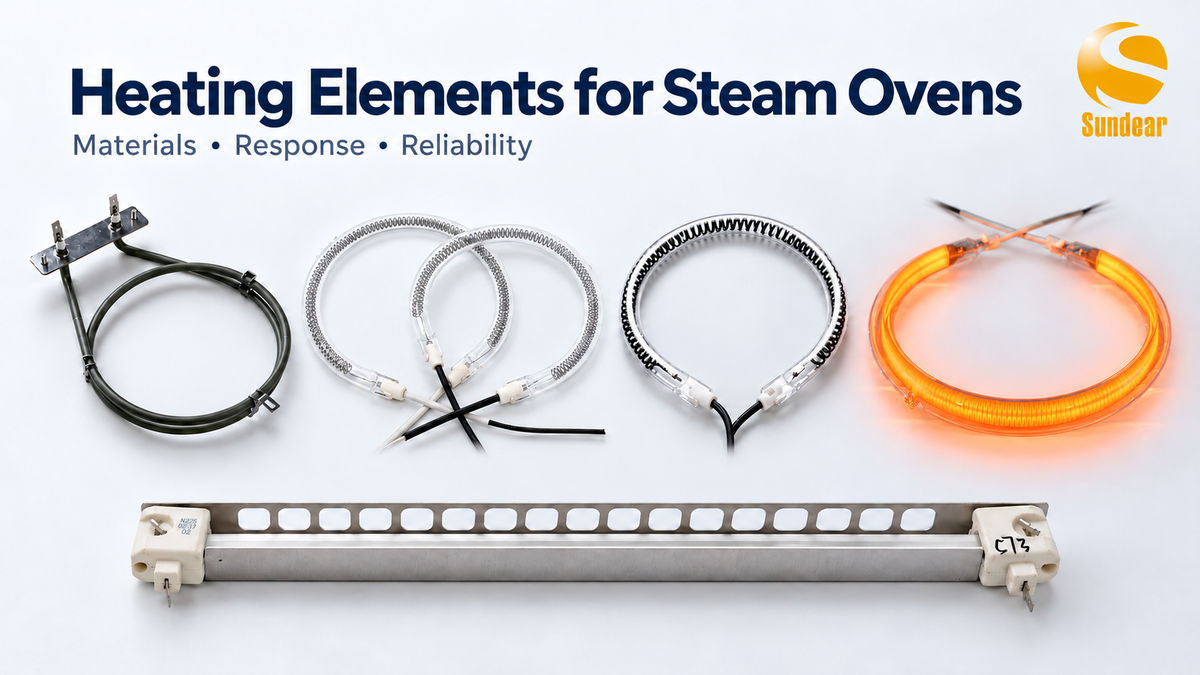
Fast thermal response is an important consideration in cooking appliance development. For manufacturers of combination steam ovens, heating element selection also involves moisture exposure, installation requirements, temperature control and project cost.
A suitable design starts with understanding the operating conditions—not simply choosing a material name.
Understanding Thermal Response
When evaluating heating performance, three different measurements should be distinguished:
- Element thermal response: How quickly the heating element’s heat output changes after power is applied or adjusted.
- Oven preheating time: How long the cavity takes to reach specified temperature conditions.
- Cooking time: How long a defined food load takes to reach the required cooking result.
These measurements are related, but they are not interchangeable.
A meaningful comparison should specify input power, starting temperature, measurement location, load and acceptance criteria. A short element response time alone does not establish faster cooking or lower energy consumption.
Comparing Heating Element Options
Terms such as stainless steel, quartz, carbon fibre and graphene can describe different parts of a heating element, including the sheath, outer tube, heating body or composite material.
Before comparing performance, manufacturers should confirm the actual construction of each proposed element.
| Heating element option | Potential advantages | Limitations and selection considerations |
|---|---|---|
| Metal-sheathed tubular elements | Flexible shaping options for different installation layouts | Thermal inertia, sheath material, surface watt density and terminal sealing require coordinated selection |
| Quartz-tube resistance elements | Suitable for evaluating radiant heating designs, with different heating-body configurations available | Mechanical protection, mounting arrangements and thermal shock require attention |
| Halogen or carbon fibre infrared elements | Options for applications requiring responsive radiant heat output | Terminal temperature, electrical connections, radiation distribution and suitability for steam exposure require verification |
| Graphene-related heating designs | An option to investigate where rapid thermal response is a project objective | Material composition, encapsulation, test conditions and cycling performance need to be established |
These considerations provide a starting point for engineering evaluation. They do not represent a universal performance ranking.
Why Steam Oven Conditions Matter
Combination steam ovens can expose components to high temperatures, steam, condensation and cleaning cycles.
Selection should therefore consider more than performance under dry heating conditions.
Electrical Performance After Moisture Exposure
Insulation, terminal sealing and electrical connections should be evaluated under representative operating conditions, including repeated steaming and drying.
Stability During Temperature Cycling
The tube, supports and connection points should be assessed after repeated heating and cooling. Mounting arrangements should accommodate the expected thermal movement.
Compatibility With Cleaning Conditions
Material and surface treatment choices should account for grease, water quality, cleaning agents and the appliance’s intended cleaning procedures.
Heat Distribution Within the Appliance
Heating elements should be evaluated together with the fan, airflow path, temperature sensors and control system. Element performance alone cannot establish temperature uniformity across the cavity.
Match the Element to Its Function
Different heating positions have different requirements.
Cavity heating elements should be assessed for radiant heat distribution, surface temperature and exposure to moisture and cooking residues.
Rear convection elements should be matched to the fan and airflow path to manage local temperatures and heat distribution.
Steam generator heating elements require evaluation against their specific water-contact or heat-transfer arrangement, including scale formation and dry-heating protection where applicable.
A specification suitable for one position should not automatically be applied to another.
Evaluate Performance at Appliance Level
To compare proposed designs, use consistent test conditions and assess:
- Preheating time.
- Cooking results and browning consistency.
- Energy consumed for a defined cooking cycle.
- Electrical and mechanical condition after endurance testing.
- Manufacturing cost and maintenance requirements.
Rapid element response may support more responsive heat control, but the resulting benefit depends on the complete appliance design.
Claims about energy savings, service life or cooking speed should be supported by relevant test results.
Selecting a Heating Element for Your Project
The appropriate heating element depends on the appliance’s operating environment and development objectives.
Metal-sheathed tubular elements can be evaluated where shape flexibility and installation requirements are key considerations. Quartz and other infrared designs can be assessed for radiant heating functions. Graphene-related designs require the same attention to construction details, operating conditions and validation.
Different heating technologies may also be used in separate functional areas of the same appliance.
Developing a combination steam oven?
Share your voltage, power, dimensions, mounting arrangement, operating temperature and steam exposure conditions with Sundear to discuss custom heating element requirements.
Final specifications, performance and suitability are subject to the agreed technical requirements and validation results.

