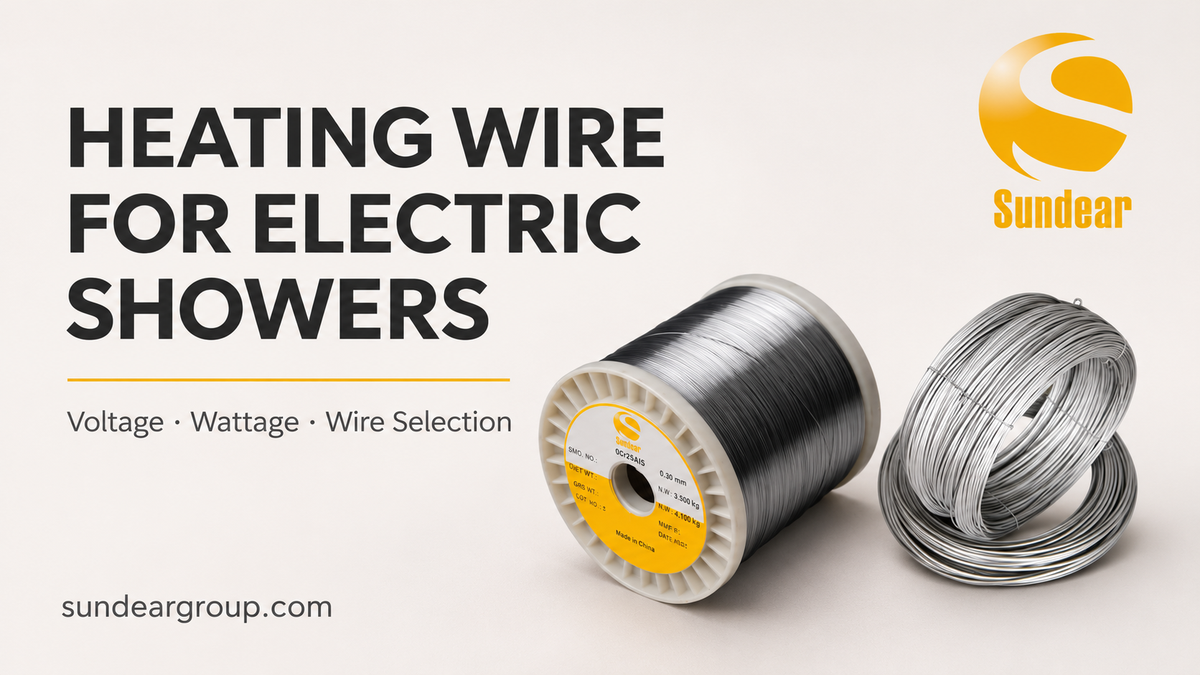
For electric shower manufacturers serving Brazil, heating element selection starts with voltage and power—but it should not end there.
A heating element must deliver the required output within a compact water chamber while handling repeated switching, changing water conditions and mechanical stresses. Matching the rated wattage alone does not establish reliable service life.
The alloy, wire diameter, coil geometry, connections and water-flow conditions all need to work together.
127V and 220V Require Different Element Designs
Electric showers sold in Brazil include configurations such as 127V/5,500W, 220V/6,800W and 220V/7,500W.
For a nominal resistive load, the following calculations illustrate the differences:
| Rated voltage | Rated power | Approximate current | Calculated operating resistance |
|---|---|---|---|
| 127V | 5,500W | 43.3A | 2.93Ω |
| 220V | 6,800W | 30.9A | 7.12Ω |
| 220V | 7,500W | 34.1A | 6.45Ω |
Values are calculated using I = P/V and R = V²/P at the stated ratings. They are illustrative operating values, rather than cold-resistance acceptance limits or electrical installation specifications.
The 127V example draws more current despite having a lower power rating. Terminal design and connection quality therefore deserve attention alongside the heating wire itself.
A 127V element and a 220V element should not be treated as interchangeable simply because their dimensions look similar.
Why Heating Wire Can Break Prematurely
Premature wire breakage does not automatically mean that the alloy grade is unsuitable. Several factors should be investigated together.
Wire Diameter and Surface Load
Surface load describes the power delivered per unit of active heating-wire surface area.
Wire diameter, active length and alloy resistivity must be selected together to achieve the target resistance within the available space. Changing the diameter without recalculating the design can alter resistance, power and operating conditions.
For the same alloy, temperature and target resistance, a thicker wire requires a greater active length. This can affect both the available heating surface and the space needed for the coil.
Coil Geometry and Support
Coil diameter, pitch and positioning influence clearances and how water reaches the heating surface.
Uneven spacing, movement or poorly positioned supports can create unfavourable local conditions. Repeatable winding and assembly processes are therefore important alongside material consistency.
Water Flow and Water Quality
The heating element and water chamber should be evaluated as one system.
Low or uneven flow, trapped air and deposits can change local heat transfer. Water chemistry can also influence material performance.
Testing should represent the appliance’s intended operating conditions rather than relying only on a dry-heating test or a single water-flow setting.
Terminals and Connections
A suitable heating wire cannot compensate for an unreliable electrical connection.
Terminal materials, contact resistance, joining methods and mechanical restraint should be assessed under representative current and switching conditions.
Recording where a wire breaks can help guide the investigation. Damage near a terminal may require a different corrective action from damage within the active coil.
0Cr23Al5 vs 0Cr25Al5: Recalculate Before Changing Grades
Both 0Cr23Al5 and 0Cr25Al5 belong to the FeCrAl resistance-alloy family. Their typical nominal resistivity values differ:
| Alloy grade | Typical nominal resistivity at 20°C |
|---|---|
| 0Cr23Al5 | 1.35 Ω·mm²/m |
| 0Cr25Al5 | 1.42 Ω·mm²/m |
These are reference values. Actual resistivity and tolerances should be confirmed against the supplier’s specification and batch test results.
Based on these nominal values, at the same wire diameter and temperature, 0Cr25Al5 requires approximately 5% less active wire length to achieve the same resistance.
This follows the relationship:
R = ρL/A
Where R is resistance, ρ is material resistivity, L is active wire length and A is wire cross-sectional area.
A shorter active length also means less wire surface area at the same diameter. If total power remains unchanged, the calculated wire surface load increases.
Changing grades therefore requires a review of active length, coil geometry and surface load—not simply substituting one material into an unchanged design.
Does Higher Resistivity Mean Longer Wire Life?
Higher resistivity alone does not establish longer service life or better resistance to breakage in an electric shower.
Alloy composition, wire condition, dimensional consistency, forming quality, connections and water exposure must also be considered.
Likewise, a material’s maximum operating temperature in air should not be used alone to predict its suitability for direct water contact.
The appropriate grade should be selected through application-specific evaluation, supported by finished-appliance testing.
What Should Manufacturers Validate?
A useful validation programme connects incoming-wire quality with finished-appliance performance.
| Evaluation area | Key checks |
|---|---|
| Incoming wire | Diameter, resistivity, surface condition and batch traceability |
| Finished element | Resistance, coil dimensions, spacing and connection quality |
| Appliance operation | Heating performance across specified voltage and water-flow conditions |
| Endurance | Repeated switching, representative water conditions and failure location |
| Safety | Applicable electrical safety requirements and operation of protective controls |
When comparing materials, define what is being held constant.
Using identical wire dimensions for two alloys with different resistivity will not produce the same resistance. Adjusting the length to match resistance will change the heating surface area.
A meaningful comparison should document these differences so that changes in performance are not attributed to alloy grade alone.
Selecting Heating Wire for Your Electric Shower Project
The most suitable heating wire is the one that meets the electrical, mechanical and operating requirements of the complete appliance.
For manufacturers, the practical priorities are consistent material properties, repeatable production and validated performance under the intended conditions of use.
Sundear supplies FeCrAl and NiCr resistance wire for heating-element manufacturing.
For an electric shower project, share:
- Rated voltage and power.
- Target resistance, measurement temperature and tolerance.
- Wire diameter and active length, if already specified.
- Coil drawing, mounting arrangement and connection method.
- Water-flow range, water conditions and endurance-test requirements.
If premature breakage is a concern, photographs of the failed area and operating records can help define the next evaluation.
Contact Sundear to discuss resistance-wire specifications for your electric shower project.
Material selection and final performance should be confirmed against agreed technical specifications and appliance testing.