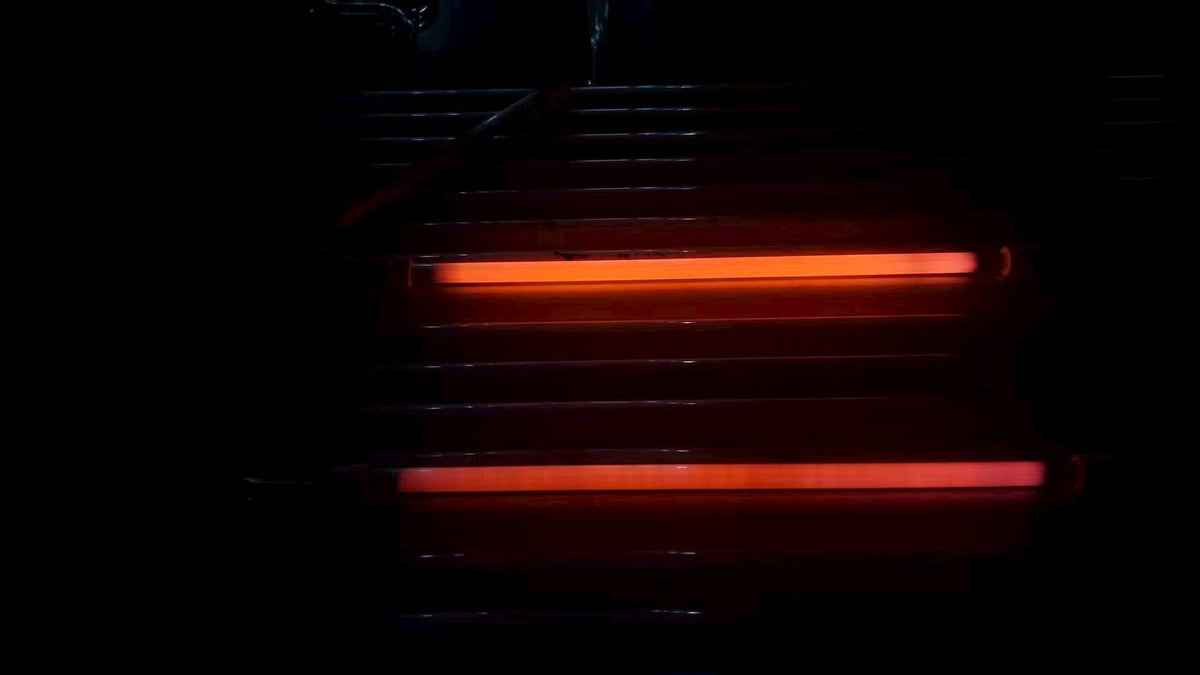
Two quartz heating tubes can have the same overall length, rated voltage and rated power, yet show different visible glow.
For appliance manufacturers, selection needs to consider three things together: heating performance, visible appearance and service life.
In comparable resistance-wire designs, increasing wire temperature usually strengthens the visible glow and can place greater demands on the material. Brightness alone does not establish heating efficiency, product quality or service life.
This article concerns metallic resistance-wire quartz heating tubes. The same conclusions should not be applied directly to halogen lamps or carbon-fibre emitters.
Illustrative operating photo supplied by SUNDEAR. The image does not verify equal measured power, wire temperature or service life, and does not establish which sample will last longer.
1. Equal tube length does not mean equal internal design
First, distinguish three different lengths:
- Overall tube length: determines the installation envelope.
- Effective heated length: the region actually performing the heating task.
- Total uncoiled wire length: the length of the resistance wire itself after unwinding the coil.
Two tubes of the same external length can therefore use different wire diameters, coil diameters, pitches and total wire lengths.
For a substantially resistive element under comparable steady operating conditions, the relationship is:
Power P = voltage V² ÷ operating resistance R
Equal measured voltage and power imply equal effective operating resistance, not equal internal construction or operating temperature.
Cold resistance also differs from operating resistance. With switched or phase-controlled supplies, compare true power and the control cycle rather than relying only on nameplate ratings.
2. Why can the same power produce different brightness?
The key is how much wire surface shares the power, and how the heat escapes.
Wire diameter, alloy resistivity, coil diameter, pitch, supports and effective heated length all influence power distribution and heat dissipation.
One important concept is wire surface load:
Average surface load ≈ power dissipated in the active wire ÷ active wire surface area
Even with equal overall tube length, internal wire surface area can differ. Wattage per tube alone therefore does not determine wire temperature. Ambient temperature, airflow and neighbouring heaters also matter.
At comparable emissivity and viewing conditions, a hotter glowing wire generally emits more visible radiation. Tube optical properties, reflectors and observation conditions also affect the apparent glow.
When comparing two samples, check:
- Whether actual electrical input power is equal.
- Whether wire temperature and temperature distribution are comparable.
- Whether tube material, reflector and installation conditions match.
- Whether camera exposure, white balance, distance and viewing angle match.
An operating photograph can show appearance differences, but cannot by itself establish which sample has higher heating efficiency or a longer service life.
3. Does brighter always mean a shorter service life?
There is no universal rule.
Wire temperature, oxidation, heating and cooling cycles, atmosphere, mechanical support and electrical connections all affect durability.
Within a similar alloy and construction, pursuing stronger glow mainly by increasing wire temperature can reduce the available durability margin.
Different materials and constructions cannot be ranked simply as brighter equals shorter life and dimmer equals longer life. A dimmer sample can still have local hot spots, poor connections or structural stability problems.
Brightness can therefore be an appearance acceptance criterion; service life needs corresponding endurance testing.
4. Can thicker wire simply be substituted to extend life?
Thicker wire can offer durability advantages under comparable conditions, but it cannot be substituted without recalculation.
Wire resistance depends on material resistivity, uncoiled length and cross-sectional area:
Resistance ≈ material resistivity × uncoiled wire length ÷ cross-sectional area
At a given material resistivity and target resistance, increasing cross-sectional area requires more total wire length.
The redesigned coil must still satisfy:
- Available space inside the tube.
- Coil diameter and pitch.
- Clearance between turns.
- Support and installation requirements.
Changing wire diameter without a corresponding change in length changes resistance and actual power.
Fitting more wire into the same tube length while maintaining suitable heat dissipation requires a complete design review.
5. How should brightness and service life be balanced?
Define the project targets before choosing the coil design.
| Project priority | Design direction | What must be demonstrated |
|---|---|---|
| Stronger visible glow | Define a repeatable brightness or approved visual-sample target; assess coil and optical design within the permitted temperature range. | Required glow together with acceptable temperature and endurance results. |
| Long operating life | Control local hot spots and surface loading; review wire size, alloy, supports and the actual switching cycle. | Durability in the intended installation, not just a continuous bench test. |
| Balanced appliance performance | Set heating performance and life requirements first, then agree an acceptable glow range. | All three requirements under the same test conditions. |
In heaters, ovens and related appliances, equal measured electrical power does not guarantee equal useful heat at the target or equal temperature distribution in the appliance.
Set the appearance requirement together with the actual heating task.
If the fixed envelope cannot meet the brightness and durability targets together, revisit the available design space or appearance requirement. Raising voltage or wattage to make the tube brighter changes the original comparison.
6. How can samples be compared meaningfully?
Use consistent, repeatable test conditions.
- First, confirm actual electrical input. Record voltage, true power, current, control mode and warm-up time; distinguish on-state power from cycle-average power.
- Second, match installation and heat dissipation. Keep position, orientation, airflow, reflector, ambient and neighbouring-heater conditions consistent. Assess wire, tube and terminal temperatures with appropriate methods and optical/emissivity corrections.
- Third, standardise the appearance comparison. Use a fixed distance, angle and ambient light, with camera exposure and white balance locked. Agree a photometric method if brightness is an acceptance criterion.
- Fourth, measure appliance heating performance directly. Examples include temperature distribution and warm-up time under a defined load; a photograph cannot replace performance data.
- Fifth, define endurance testing and failure criteria. Agree cycles, sample quantity and acceptance conditions, and record wire failures, resistance or power drift, coil deformation and connection condition.
A short successful operating trial does not establish a specific service life.
What should you send SUNDEAR for an evaluation?
To clarify brightness, heating performance and durability requirements, provide:
- Overall dimensions and effective heated length.
- Rated voltage, power and control method.
- Installation orientation, airflow and reflector arrangement.
- On-time and switching cycle.
- Target glow or an approved reference sample.
- Operating environment and endurance requirements.
- Drawings and proposed acceptance tests.
A sound selection meets the required heating result and service life within an agreed appearance range. Any brightness or lifetime commitment should be supported by testing of the final design.
SUNDEAR can discuss a suitable quartz heating tube design with customers based on project drawings, specifications and operating conditions.
Related products and support
Resistance wire | Quartz heating elements | Technical Center | Discuss your specifications